




📰 The Natural Living Newsletter November 2025
Stay informed. Stay grounded. Stay real.
Hi,
I’m Dr. Andres Digenio. October brought a mix of fresh evidence, meaningful policy change, and practical guidance for daily life — from controlled trials and population studies to the aisles of your local grocery store. Below you’ll find the latest insights, written to help you cut through confusion and stay focused on what truly shapes our health: the way food is built, chosen, and lived with.
Ultra-Processed Foods Under the Microscope — What the New Danish Trial Really Shows
A new randomized trial from Denmark gave us one of the clearest looks yet at how ultra-processed foods affect behavior and physiology. Participants following a minimally processed diet naturally ate less, felt fuller sooner, and showed improved metabolic markers — all without being told to restrict portions. The key wasn’t the calories or macronutrients, which were carefully matched between diets, but the structure of the food itself: texture, density, additives, and how fast it could be eaten. This study reinforces what we’ve seen before — that “how” food is made matters as much as “what” it contains, and that real foods naturally create balance where formulas and flavors try to imitate it.
🔗 Read the full article
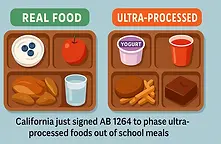
Signed: California Will Phase Out Ultra-Processed Foods in School Meals
After months of debate, California officially signed AB 1264 into law, becoming the first state to phase ultra-processed foods out of public-school meals. The law gives cafeterias a clear framework for identifying these products — not by marketing claims, but by ingredient lists. It targets foods built from additive stacks (flavors, colors, emulsifiers, sweeteners) combined with excess sugar, salt, and saturated fat. Over time, it will replace these with plain yogurt, fruit, vegetables, beans, and simple grains. This is a milestone for school nutrition policy and a model for how institutions can move from slogans to standards.
🔗 Read the article
Ultra-Processed Foods and Early Death
A growing body of cohort studies now points in the same direction: higher intake of ultra-processed foods is consistently associated with increased all-cause and cardiovascular mortality, even after adjusting for overall diet quality and lifestyle factors. While no single study is perfect, the convergence of evidence across countries and populations is striking. These findings remind us that this is not a niche concern or a passing health trend — it’s a structural issue woven into our food system. The message remains simple: every shift toward real food counts, and consistency matters more than perfection.
🔗 Read more
Why Ultra-Processed Foods Make Us Eat More — Evidence from Three Experiments
Three tightly controlled feeding studies — one in the U.S., one in Japan, and one in the U.K. — have shown that people eat significantly more when their meals are dominated by ultra-processed foods, even when those meals have identical calories and macronutrient profiles (same composition of carbohydrates, fats and protein) to their minimally processed counterparts. Those assigned to the ultra-processed meals ate faster, felt full later, and ended up taking in hundreds more calories each day—without realizing it. The takeaway isn’t about self-control; it’s about environment and engineering. When food is designed for speed and constant reward, our biology reacts accordingly. Changing what surrounds us may be more powerful than trying to outthink it.
🔗 Read more
Beyond the Label — How to Spot Ultra-Processed Foods While You Shop
For anyone still wondering how to tell “processed” from “ultra-processed,” this practical guide breaks it down aisle by aisle. Instead of demonizing convenience, it focuses on cues you can use in seconds: additive clusters (colors, flavors, emulsifiers, sweeteners), refined bases that replace real ingredients, and engineered textures that mimic homemade foods. The simplest rule still holds true — if most of the ingredients wouldn’t live in your kitchen, it’s probably ultra-processed. Replacing even five or ten items in your weekly cart with simpler versions can make a measurable difference over time.
🔗 Read the full guide
Reader Favorites — Five Quick Plays from November
This short list captures the practical habits readers responded to most — small, repeatable changes that steadily move your diet away from ultra-processed foods (UPFs) without feeling restrictive:
-
Breakfast anchors that keep you steady:
Simple morning routines like oats, eggs, or plain/Greek yogurt with fruit set a stable tone for the day. These meals offer slow-digesting carbs and real protein, helping reduce the urge for UPF snacks later. -
One-aisle upgrades:
Instead of overhauling everything, focus on just one aisle at a time — bread, yogurt, cereal, or snacks — and trade your most frequent UPF for a simpler version you’ll actually eat. Over time, these “micro-swaps” reshape your whole pantry. -
Snack setups that work for you, not against you:
Keep fruit, nuts, and water visible and within reach. Hide or store UPF treats out of sight or on high shelves. Visibility changes behavior; what you see first is what you tend to grab. -
Cook-once, eat-twice habits:
Prepare one versatile ingredient — a batch of beans, roasted chicken, or a grain like quinoa — on Sunday. Remix it during the week into bowls, wraps, or quick dinners. It makes home meals faster than packaged ones. -
Simple sauce swaps:
Many UPFs hide in condiments and dressings. Replace them with quick mixes of olive oil, lemon juice, herbs, or yogurt. You get flavor without the stabilizers, emulsifiers, and hidden sugars common in bottled versions.
Together, these “quick plays” prove that real change doesn’t depend on drastic diets or perfect discipline — just better defaults repeated often.
Small changes, big pattern shifts.
If these stories help you, please forward this newsletter to a friend or family member who’s curious about what we’re really eating — or share a favorite article on social media. That’s how this real-food movement grows, one plate at a time.
To real food,
Dr. Andres Digenio
Physician • Author of The Natural Diet (February 2026)
📬 Subscribe to receive The Natural Living Newsletter during the first 5 days of each month: andresdigenio.com/newsletter